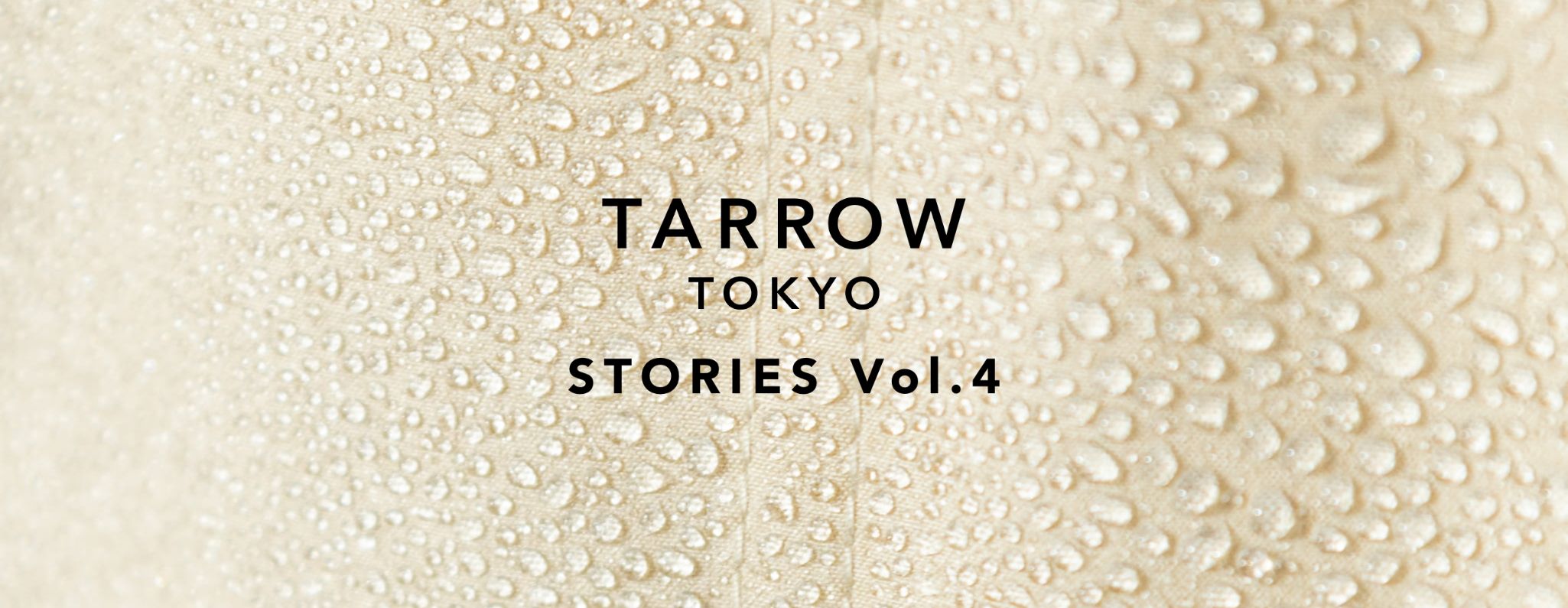
STORIES Vol.4 Making a coat using the strongest cotton fabric

-In this development story, I would like to ask you about the additional production of the "Balcon Collar Coat."
I have the impression that Taro hasn't made many heavy clothing items up until now, but the fact that he is making additional production suggests that he must have a strong attachment to the coat. What made you decide to make the coat in the first place?
Taro A: I do have strong feelings about it. I've been thinking about coats ever since I decided to start Taro. I want a coat, but it's expensive, and cheap ones are cheap for a reason, so I wanted a coat that I could be satisfied with.
However, it was difficult to find a fabric that I wanted to use and that inspires me to be productive, and it took me quite a while to find one.
- I see, that's how it is. It certainly has a firm texture and shine, and I thought it was a high-quality, sturdy fabric. Could you tell me more specifically what kind of fabric it is?
Taro A: Simply put, it's the strongest cotton fabric (laughs).
It is a historic fabric that requires advanced skills to make, and there is only one factory in Japan that can weave it. The craftsmen there failed many times before they were finally able to make it.
Specifically, it is woven at a very high density, is water-repellent despite being 100% cotton, and is made using advanced technology so the color does not fade easily even with long-term wear.
It's so dense that the coat stands up (laughs).

It is a reproduction of a fabric originally developed by the Royal Air Force, and in addition to being water-repellent, it is also fire-resistant, moisture-permeable, and breathable. It is also known as gabardine (Burberry weave). It is a fabric that continues to be valued by high-end brands in the UK, France, and Italy. At the time, it was highly valued for its functionality, but as time passed, cheaper, more durable fabrics became available and the demand for it disappeared for a time. However, it is a very rare fabric that has been beautifully reproduced by Japanese craftsmen. I think it is the finest cotton coat.

- It's amazing that a fabric that is so highly regarded around the world is made in Japan. Indeed, with such high specs, you can imagine it being something you can wear for a long time.
Taro hasn't released many high-priced items, but this coat was a bold move. Did you have any doubts?
Taro A: So it's expensive? (laughs) For this quality, this price is actually a bargain! However, since it's an unknown brand, I was worried about whether it would be accepted.
But now I'm glad I made them, because I often receive compliments at pop-ups around the country, and I also hear kind words from people who have bought them.
- It's nice when people who have made something they think is good are happy with it and can relate to it. It seems like you put a lot of effort into the specifications and design of the buttons. What did you pay attention to?
Taro A: In terms of specifications, the back has a center vent (a design with a single slit in the center of the back hem) that can be adjusted with a button. We designed it that way so that you can wear it for a long season and adjust the temperature.
The patterns are also designed with ingenuity, such as eliminating side seams in order to eliminate seams as much as possible. 
-So that was the background. Lastly, please tell us why you yourself are glad to have this coat.
Taro A: The good thing about it is that you can wear it regardless of the weather.
On sunny days, you can really see the luster and firmness of the fabric, and it gives you a sense of satisfaction in wearing it, like a sophisticated piece for adults. And on rainy days, it doesn't get wet at all.
Even when I used an umbrella, my shoulders would get wet or I would notice parts of my clothes getting wet, but now that has completely stopped.
It's high density and windproof, so it can be worn in a variety of climates!
So, there are probably many moments when you feel that its functionality is good after all.